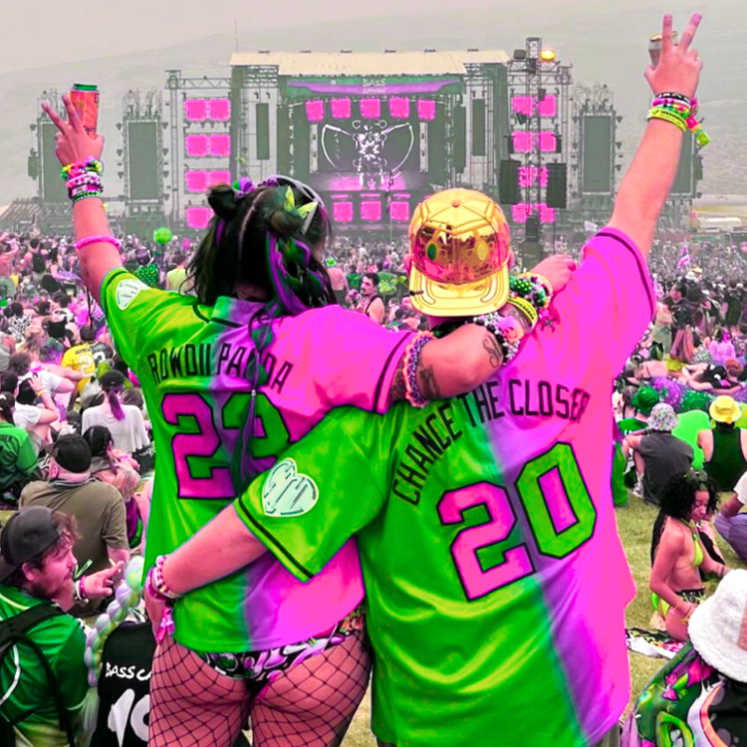
The Artist Who Built His Own Stage Deserves a Shot at the Biggest Ones
Why Chance the Closer belongs in the conversation for EDC, Tomorrowland, Bass Canyon, and Ultra Music Festival.
There is a peculiar contradiction at the heart of electronic dance music: an industry built on discovery can make it extraordinarily difficult to be discovered.
Every year, the world's biggest festivals unveil elaborate stages, spectacular production, and lineups featuring artists whose names have become practically synonymous with the events themselves. They are celebrations of electronic music's remarkable evolution—from underground warehouses and makeshift sound systems to a global cultural force worth billions.
But beneath the headliners, behind the carefully orchestrated announcements and increasingly sophisticated marketing campaigns, there is another electronic music industry. One that operates without enormous promotional budgets, international booking agencies, or teams of people manufacturing viral moments.
It's an industry sustained by producers finishing tracks after work, DJs organizing nights nobody else would organize, and artists who continue investing in their communities long before those communities can afford to invest much in them.
Chance the Closer belongs to that world.
And there is a compelling argument that he belongs on some much bigger stages, too.
More Than a Name on a Lineup
Based in Oregon's Pacific Northwest, Chance the Closer is a DJ, producer, father, and farmer whose career has developed considerably further than his public profile might suggest.
His artist materials document more than 300 singles and 20 studio albums, with releases associated with Blanco Y Negro, Bassfeature, Glitchworld Recordings, LFTD Global, and other independent labels. He has supported Cyclops at Portland's 45 East, performed at regional festivals, headlined club events, and maintained residencies at venues including Jungle Bar and the Barrel Room.
These are not imaginary credentials assembled for a festival application. They represent years of sustained work.
Yet the numbers tell only part of the story.
Electronic music has never suffered from a shortage of producers capable of finishing a track. What it needs is people willing to build something around the music—people who understand that a local scene doesn't simply materialize because somebody has purchased a pair of CDJs.
Chance has worked on that side of the equation as well.
Through projects including Aura Points, The Give Back, and recurring Portland events, he has helped organize opportunities for emerging DJs, bring audiences together, and connect music with charitable causes.
There is something quietly significant about an artist who spends his time trying to get other people onto stages while continuing to chase a larger one for himself.
It's not particularly glamorous work. Someone has to coordinate the performers, promote the event, communicate with the venue, and convince people to leave their houses on a Thursday night.
Sometimes, the person doing all of that is also the person playing the closing set.
That experience doesn't automatically produce a great festival DJ. It does, however, produce a different understanding of what a dancefloor means.
The Music Still Has to Matter
Chance's music moves through bass house, dubstep, trap, techno, and related corners of contemporary dance music.
His catalog includes the seven-track ANTI RENEGADE RENEGADE CLUB, released in October 2026, with titles including "CHROME," "BASSWAR," and "BIG BEHAVIOR." The project reflects his increasingly bass-oriented direction, while the wider discography demonstrates a willingness to explore different sounds rather than remain confined to one subgenre.
Versatility can be a strength, although it presents a challenge: festivals need to understand exactly what an artist brings to a particular stage.
An effective bass house set and an effective riddim set are not interchangeable. One relies on the elasticity of its groove, the relationship between percussion and low-end, and the way tension can be sustained through repetition. The other may demand sharper contrasts, aggressive sound design, rhythmic interruption, and drops engineered for physical impact.
The common denominator is judgment.
A DJ needs to understand when a crowd wants another hit of energy and when it needs a moment to breathe. When to introduce an unexpected record. When to let an original track speak for itself. When to resist the temptation to do too much.
Those qualities cannot be established by discography statistics alone. They have to be demonstrated in front of people.
Which is precisely why an artist like Chance needs the opportunity to demonstrate them on a larger platform.
EDC: Where Discovery Should Still Mean Something
Electric Daisy Carnival is one of dance music's most powerful symbols of possibility.
For many artists, EDC Las Vegas represents something larger than a prestigious booking. It represents the moment when years of work in smaller rooms finally become visible to the wider community.
Chance has made no secret of the fact that performing there is a personal ambition.
But his case for EDC is more substantial than simply wanting to be there.
The festival's bassPOD programming accommodates the heavier side of his musical identity, while stereoBLOOM's broader approach to house and bass provides another potential entry point. Even an art car set could offer an opportunity to introduce his music to an audience that has not encountered it before.
And isn't that one of the most exciting experiences a festival can provide?
Finding a DJ you didn't plan to see. Walking past a stage because something in the mix catches your attention. Staying because the person behind the decks has turned a passing curiosity into an unexpected highlight.
Not every memorable EDC performance needs to come from someone whose name dominates the poster.
Sometimes a new favorite artist is discovered at a smaller stage, early in the evening, with nothing to lose and everything to prove.
Chance has built a career around the idea that dance music should be energetic, welcoming, and capable of bringing people together.
That belongs in the EDC conversation.
Tomorrowland: The Universal Language of the Dancefloor
Tomorrowland presents a different challenge.
Its worldwide audience, expansive programming, and deep connections to European electronic music culture make it one of the most competitive destinations for aspiring festival artists.
But Tomorrowland's identity has never depended on one musical style.
Its programming spans house, techno, bass music, trance, hard dance, and numerous variations of all of them. Its 2026 edition included bass-focused stage hosting from Rampage and collaborations with Bassrush, alongside the festival's enormous range of other musical experiences.
That diversity creates an interesting opening for an artist whose background crosses multiple electronic genres.
Chance's appeal here would not be an imitation of the stadium-scale spectacle associated with Tomorrowland's biggest headliners. It would be a carefully constructed set that brings his own perspective to a specific corner of the festival.
There is a meaningful distinction between trying to sound like whoever is currently successful and having spent years working through enough different musical ideas to develop your own approach.
Tomorrowland should be a destination for artists with something personal to communicate, whether that communication arrives through a soaring melodic breakdown or an unapologetically abrasive bassline.
And there is something appealing about the prospect of an Oregon farmer, who spends much of his life far removed from the international festival circuit, stepping behind the decks in Belgium and discovering that thousands of strangers understand exactly what he's trying to say.
No elaborate explanation required.
Just music.
Bass Canyon: The Most Natural Next Step
Of these four festivals, Bass Canyon may present the clearest immediate opportunity.
Held at Washington's Gorge Amphitheatre, the festival has become a major destination for dubstep and bass music. Its audiences arrive expecting intensity, adventurous sound design, and the kind of low-frequency pressure that makes the physical experience inseparable from the music.
For a Pacific Northwest artist already operating in that musical territory, the connection is obvious.
Chance has performed in the regional scene, shared a bill with Cyclops, and developed an increasingly heavy catalog. His separate Bassgression identity also gives him a way to concentrate specifically on harder dubstep and riddim.
A Bass Canyon appearance wouldn't require him to abandon his musical identity or manufacture an entirely new one. It would require him to refine an existing direction into a particularly focused festival performance.
The Gorge is also relatively close to the region where he has been helping develop live electronic music events.
That matters.
Regional festivals can play an important role in connecting promising local talent with the international artists who dominate their lineups. There is value in letting the audience see that meaningful music careers are being built in the communities surrounding these enormous events.
An early Bass Canyon slot would offer Chance an important test: could the technical preparation, original material, and crowd-reading instincts developed in smaller rooms translate to one of the most demanding bass music audiences in the country?
That is a question worth answering.
Ultra: A Bigger Platform for an Independent Vision
Ultra Music Festival operates in a highly visible corner of the global electronic music industry. A compelling performance in Miami can introduce an artist not only to festival attendees but also to international promoters, industry professionals, and listeners discovering performances online.
Ultra's programming is broader than its mainstage reputation might suggest. In recent years, the Worldwide and UMF Radio stages have accommodated a variety of electronic sounds, including bass-oriented artists.
For Chance, the strongest initial opportunity would be a deliberately curated appearance on a stage that suits his bass house and heavier electronic material.
But Ultra's significance goes beyond the potential audience.
It would place an independent artist who has spent years learning to operate without a major industry infrastructure in an environment where every detail matters: musical selection, pacing, performance discipline, stage presence, and the ability to establish an identity in a limited amount of time.
For an artist who has already spent years recording music, performing, and producing events, that is a meaningful next challenge.
And for a festival that showcases electronic music to a worldwide audience, discovering a compelling new performer is part of the appeal.
The Problem With Waiting for Permission
None of this means that Chance the Closer is entitled to a place on any particular lineup.
Festival bookings are complicated. Audience demand, artistic direction, relationships, routing, financial considerations, and countless logistical details influence the decisions.
There are many excellent artists competing for a limited number of opportunities.
Nor should artistic persistence be confused with artistic excellence. Releasing hundreds of songs is evidence of productivity, not automatic proof that every record deserves attention. Organizing community events is admirable, but it doesn't replace the responsibility to deliver an exceptional performance.
These are fair distinctions.
Still, there is a danger when an artist's opportunities become disproportionately determined by how much attention they have already received.
It creates a circular problem: the artists most likely to receive meaningful exposure are often the artists who already possess it.
Meanwhile, capable performers continue developing outside the spotlight, sometimes for years, without receiving the opportunity that could fundamentally change their careers.
Electronic music has a history of challenging those kinds of barriers.
It emerged from communities that found freedom in creating spaces of their own, using technology in unexpected ways, and celebrating sounds that established institutions initially struggled to understand.
That history should mean something when deciding who gets access to the biggest stages.
Something Worth Remembering
Away from the clubs, Chance's daily life involves raising a family and maintaining a farm in rural Oregon.
It is a notably unglamorous counterpart to the world of festival wristbands, hotel suites, elaborate stage production, and backstage photographs.
But perhaps it also explains something about his persistence.
When music isn't the only responsibility in your life, continuing to pursue it requires deliberate choices. There are easier ways to spend an evening than making another track that may never find its audience. Easier ways to spend a weekend than organizing an event that may barely cover its costs.
Yet people continue doing these things.
Not everyone who dedicates a lifetime to music will become a headliner. That has always been true, and it always will be.
But there is a meaningful difference between recognizing that reality and accepting that the industry's gates should remain closed to artists who haven't already achieved widespread recognition.
Chance the Closer has not yet established himself as a major international festival draw. It would be misleading to suggest otherwise.
What he has established is a body of work, real performance experience, a presence in his regional music community, and a commitment to a career that has continued through the ordinary demands of adult life.
That is a credible foundation for the next opportunity.
Give Him the Set. Let the Music Decide.
EDC doesn't need Chance the Closer to sell out the Las Vegas Motor Speedway.
Tomorrowland doesn't need him to replace a global headliner.
Bass Canyon doesn't need him to command the Gorge at midnight.
Ultra doesn't need him to arrive as the next internationally recognized superstar.
Not yet.
What these festivals can offer is something more fundamental: the opportunity for an artist who has spent years creating music and building a community to demonstrate what he can do when the audience, sound system, and platform grow larger.
Give him an opening set. A smaller stage. A carefully selected slot where his sound fits the audience and the festival's artistic direction.
Evaluate the music. Evaluate the performance. Evaluate the response.
Let him earn whatever comes afterward.
Because the next generation of electronic music cannot be built exclusively by celebrating the artists who have already arrived.
Somewhere, right now, a producer is finishing a track after putting the kids to bed. A promoter is wondering whether enough people will show up to keep a local event alive. A DJ is rehearsing transitions for an opportunity that might never come.
Some of those people will eventually shape the future of the culture.
The industry just has to be willing to hear them before everyone else does.
Chance the Closer deserves to be heard. And EDC, Tomorrowland, Bass Canyon, and Ultra would be worthwhile places to start.
© Copyright Amazonrents